Sunday, December 11, 2016

Backward Mapping in IBDP Computer Science

The backward mapping technique allows us to produce quality lessons for our students, designed and aimed purposefully to help them meet the standards determined by schools and/or state.  In my currently teaching Year 1 (Grade 11) Computer Science following the International Baccaulerate diploma programme. For my specific case, those standards are the one determined by the IB organization, in their IBDP Computer Science guide.  These standards are the ones students are expected to be able to use in their final examinations, and internal examinations in order to be granted with credit for completion of the course.

I will be illustrating the backward mapping process in this post through the use of one of said standards. Specifically, standard 2.1.4: Describe the stages of the fetch-execute cycle, including the use of registers.  

The reason why I chose this standard is because is a complex topic normally new for students taking the course, and it could be a challenging one if not approached appropriately.  Additionally, this is one of the standards I will be teaching in my next unit, and I think is just common sense to try and use something that will be useful and meaningful for my work.
In preparation for designing this activity, additional to the IBDP Computer Science mentioned before, I have supported my design with the Syllabus and Scheme of work provided by Cambridge, for the IGCSE Computer Science course 0478.  I’ve chosen these documents, as this is a topic common between the 2 curriculums, both in its content and in its approach.  Additionally, I am also teaching the IGCSE CS Curriculum to 10th grade students (year 2 of this course), so I believe this planning will be helpful as well, for the future or other teachers, teaching this lesson to 9th grade students (with some modification on the assessments).
Stage 1:  By unpacking the standard, the following Big Ideas, skills, knowledge and understandings were identified for the standard:
Big Ideas:
·             Stages of the fetch-execute cycle
        Use of registers in the fetch-execute cycle
Key Knowledge/Skills/Understandings
Skills - Students should be able to
Knowledge -  Students will know:
Understandings – Students will understand
Identify the computers components involved in each one of the stages of the fetch-execute cycle.
Describe each one of the stages in the fetch-execute cycle.
Explain how data is transmitted from one stage to the next one in the fetch-execute cycle.
Explain the function of the different registers in each one of the stages of the fetch-execute cycle.
The different components of the CPU and primary memory involved in the fetch-execute cycle.
The different stages of the fetch-execute cycle.

that every process in a computing system needs to be broken down to fundamental tasks that can be executed on a fetch-execute cycle.
the different roles of the CPU and the main memory in the fetch-execute cycle.


These leads to the following proficiencies identified for the standard:


  • By the end of the unit students will be able to explain each one of the different stages of the fetch-execute cycle.
  • By the end of the unit students will be able to identify the components involved in each one of the stages of the fetch-execute cycle.
  • By the end of the unit students will be able to describe the contents of different registers during each one of the stages of the fetch-execute cycle.

Stage 2:
After identifying the learning objectives, we proceed with designing assessments that will help us know if the students are meeting the standard
Examples of some of the possible assessments for this standard are:

  • Performance task/project:  Students use a LMC (Little Man Computer) software to carry out a low level task that allows them to track the changes made to specific registers during a small series of fetch-execute cycles.
  • Quiz:  Students will take a quiz with exam type questions checking for understanding of the concepts.  Quiz could also check for register names and its uses.
  • Observation:  Students work in groups practicing to track the content of registers during a fetch-execute cycle.  Teacher keeps an observation journal looking for misconceptions.
  • Performance task/project:  Students create their own visual representation of the fetch-execute cycle, containing descriptions of the components involved and the actions involved on each stage.
Stage 3:
Finally, based on the assessments we are expecting students to complete, we identify the activities or learning experiences we will create in our classroom to help students meet the standard.
The following are potential activities linked to the expected outcomes in the evaluations designed in the previous stage:
  • Teacher demonstrates each one of the stages with the use of a java program or a LMC program.
  • Teacher and students role-play the fetch-execute cycle for a short program, acting as components of a CPU or main memory.  They can “hold” registers values on a small white board.
  • Students create one-pagers for each one of the names of the components and registers’ names, as a strategy for vocabulary building for SLL students.

In conclusion, and after following the UbD design, it is possible to come up with a teaching plan that is purposefully designed to comply with the standards stablished by the IBDP program.


References:


Hidden curriculum (2014, August 26). In S. Abbott (Ed.), The glossary of education reform. Retrieved from http://edglossary.org/hidden-curriculum
McTighe, A. (1997). Assessment Framework [PDF]. Washington: National Education Association.
Wiggins, G. (2003). Overview of UbD & the Design Template [PDF]. ASCD.

Saturday, November 26, 2016

Flowchart your behaviour reactions

by:  Mery Tellez

Considering the when and how to react to our students’ behaviors is a tricky business.  The language we utilize, our tone of voice and body gestures, have a big impact on classroom situations.  For any situation that arises in a classroom, its meaning is tremendously impacted by our reaction to it.
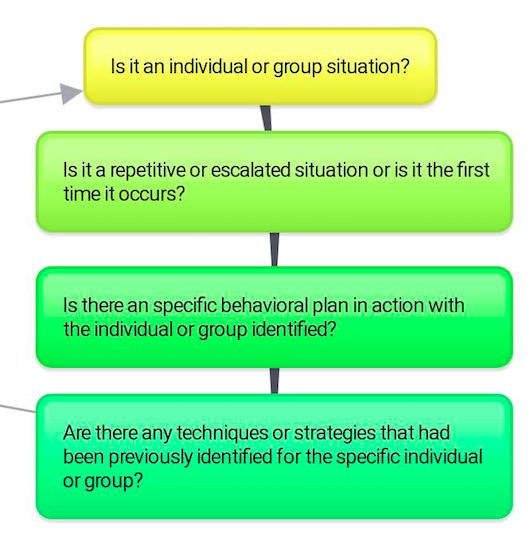
Regardless of the set of specific consequences we are planning to implement in our classroom and if the behavior and consequence is a positive or negative one; there is a general process that we do need to go through every time a situation arises in our classroom.  The flowchart provided here is an attempt to organize this internal process.  Being conscious of what we should be doing to ensure an effective classroom management is certainly the first step to building a positive learning environment for our students.

 
The flowchart starts at the beginning of the school year, when rules, procedures and consequences should be discussed and agreed on together with the students.
Socializing these three components, and allowing your students to be part of the process, will facilitate the understanding of your future efforts to promote positive classroom behavior.  Imagine you are keeping the entire classroom for 5 extra minutes during their recess as a consequence of your never socialized rule of being on time, how many students will be upset, frustrated and probably even offended by your decision?  Contrast this against the scenario of a class that starts the school year by deciding what is important; being on time for example, and how can we compensate the time lost if we are not on time; taking time from recess. Certainly the students' reaction will be a very different one.

After that we can see how the flowchart moves towards the many specific situations both positive and negative that you will experience in your students’ behavior.  For each situation a suggested course of action is presented in a general approach:

The first identified step is to make sure to have all the information you require to make a judgment.  Imagine for example that you have agreed on individual work time with your class.  While you are working individually with a student, you turn and you see a student coming back to his/her chair after having “interrupted” another student work.  Acting without proper information might result on this student being penalized for a misbehavior.  Inquiring first, and aiming to get as much information as possible about the situation might allow you to realize the student was helping with translating instructions, or providing pieces from the prior group work to his/her classmate turning the entire situation around.  Snap judgments are not good advisors, particularly when aimed to students with prior positive or negative behaviors as our judgments tend to be biased in those situations.

Once you are sure you have enough information, the next step involves a sub-routine in which you will need to make questions that will guide you through the specific course of action required.  There are many possible consequences that could be stablished for many different behaviors, with varying effects on repetition and student learning.  The only and best way to go about deciding how to react and what strategy to use is by knowing your students and being consequent with what you have previously stablished.   The questions suggested will help you to decide what should be the most appropriate strategy to use.
For example, if a student is raising her hand wanting to participate, you can immediately detect that as a positive behavior and move forward on your plan to praise it or recognize it.  If you stop for a second on the suggested questions, you might remember that this is the same student who has been praised for the same behavior constantly, and might remember as well how over-praising a behavior makes it lose its meaning, not really building up the skills or motivation of said student, and you might change your reaction to a more subtle and meaningful one, such as acknowledging her with a nod or a smile.

Finally, after applying the selected consequence, positive or negative, there is a step that I consider crucial in the process of building a positive environment in my class. Keeping record!  This might change from person to person, and some do keep a public record (class dojo, stop signs, behavioral charts) as a way for the students to have a visual reminder of the expectations the teachers have for them.  For others, myself included, the record keeping is more of a strategy to inform my own future actions.  I am a specialist teacher in MS and HS, this means that I do not spend my day with the same group of 18-40 students, but instead I have an average of 100 – 400 students that I see once or twice a week, or only for one period per day.  Keeping a mental track of their behaviors have proved not to be the most effective way to go about this in the past, and using any of the many options to keep an anecdotal record of what had happened in each one of my classes has greatly helped me to be more efficient on my questioning stage.

To close this post, I would like to make a short reflection on consequences.  Marzano, (2007) in his chapter on recognizing and adhering to classroom rules and procedures, stablishes that “Rules and procedures for which there are no consequences do little to enhance learning”.  I couldn’t agree more, but I do believe we need to re-evaluate what most of us do as a consequence, its frequency, and its effects in building our students’ character.

How much do consequences help to educate and bring the best possible out of a child, and how much are these systems of punishment and reward a detrimental system that hurts better tan build students-teacher relationships? 
There are many teachers who believe that our reward-penalize system is not one that in fact reflects the real world our students live in, and that by constantly making an effort to even visually point out a misbehaviour or a positive behavior that should be expected, we are in fact placing the job of managing students’ behavior in the hand of the teacher and not in the hands of the students where it belongs.  In this scenario the students become the object of a judgment instead of the self-regulators of their behavior that we were originally aiming for.
The reality is that as adults we are not constantly being praised or penalized for our good actions or small faults.  We do face consequences in the long and short term for our actions, but the ideal I would like to help build in the character of my students is one in which their actions are not determined by the fear or need for the immediate or long term praising, but instead for their inner motivation to act according what they believe correct. 
With that being said, I believe we should be motivating much more self-reflection and much less candy and stickers for behaviors that should be the norm.  Should we really be so surprised that our students remain in line? Or submit homework? Or get to class on time?   I believe that by praising those behaviors that are an expectation better than an extraordinary action, we are educating our students to act based in a reward and not on their convictions.

Cited Sources:
Marzano, R. J. (2007). Chapter 7. What will I do to recognize and acknowledge adherence and lack of adherence to classroom rules and procedures? In The art and science of teaching: A comprehensive framework for effective instruction(pp. 131-148). Alexandria, VA: Association for Supervision and Curriculum Development.